
AIF’s in GIFT City: The 2026 Playbook for Fund Managers and Indian BFSI

The fund management landscape is shifting at GIFT City. As of December 2025, IFSCA hosts more than 272 registered funds with cumulative commitments crossing US$8 billion, and from April 2026, mutual funds can relocate from Singapore and Mauritius to GIFT City without triggering capital gains tax.
Alternative Investment Funds in GIFT City sit at the heart of this shift. The International Financial Services Centres Authority (IFSCA) has built a unified regime under the IFSCA Fund Management Regulations 2022 that rivals Mauritius and Luxembourg on paper and beats them on cost.
For Indian sponsors, the proposition combines foreign currency operations, zero withholding tax for non residents, and a 20 year tax holiday extended through Budget 2026. The question is no longer whether to evaluate GIFT City. It is how fast you can build there.
Why Are Alternative Investment Funds in GIFT City Outpacing Domestic Structures?
- Domestic AIFs under the SEBI regime face four headwinds that GIFT City removes.
- The minimum ticket in a domestic AIF is INR 1 Crore, whereas GIFT City allows USD 75,000 for specified retail schemes notified in February 2025.
- Category III AIFs in India bear fund level taxation at 39 to 42 percent, while Cat III AIFs in GIFT City are exempt under Section 10(23FBC) of the Income Tax Act, 1961.
- Domestic AIF returns suffer a 1 to 2 percent drag from STT, stamp duty, and 18 percent GST on management fees, none of which apply in GIFT City.
- NRIs investing domestically must maintain NRE or NRO accounts with PAN and ITR obligations, while GIFT City AIFs grant full PAN and ITR exemption for Cat I and Cat II structures.
The market has priced this in. Foreign commitments to GIFT City funds crossed US$5 billion in FY2025-26 against US$2 billion from domestic sources. With 35 million Indians living abroad, the domestic AIF can no longer serve as the default vehicle for cross-border pooling of Indian opportunities.
The IFSCA Framework and FME Licensing Roadmap
Setting up an AIF in GIFT City begins with registering as a Fund Management Entity (FME) under the IFSCA Fund Management Regulations 2022. Elefint recommends this sequenced roadmap for Indian BFSI firms.
- Months 1 to 2, FME Application. File a pre-application consultation via the IFSCA SWITS portal, then submit the formal application with a minimum US$500,000 sponsor commitment for non-retail FMEs. Approval takes 30 to 45 working days.
- Months 2 to 4, Fund Vehicle Setup. Incorporate the scheme as a trust, LLP, or company. Draft the Private Placement Memorandum referencing IFSCA FAQs for Category I, II, or III classification.
- Months 3 to 5, Banking and Custody Rails. Open an IBU account in USD with HDFC, ICICI, SBI, or Axis. Appoint a SEBI-registered custodian and an IFSCA-recognised fund administrator.
- Months 4 to 6, Onboarding Infrastructure. Build a dedicated GIFT City KYC stack separate from CKYCR and SEBI KRA, integrate video KYC per the IFSCA July 2025 circular, and deploy payment gateways for LRS inflows.
- Months 5 to 7, First Close and Launch. Raise sponsor and anchor commitments, complete first close, and commence capital deployment.
The full cycle runs six to eight months for disciplined BFSI players with a clear product mandate and technology readiness.
What Tax and Operational Advantages Define GIFT City AIFs?
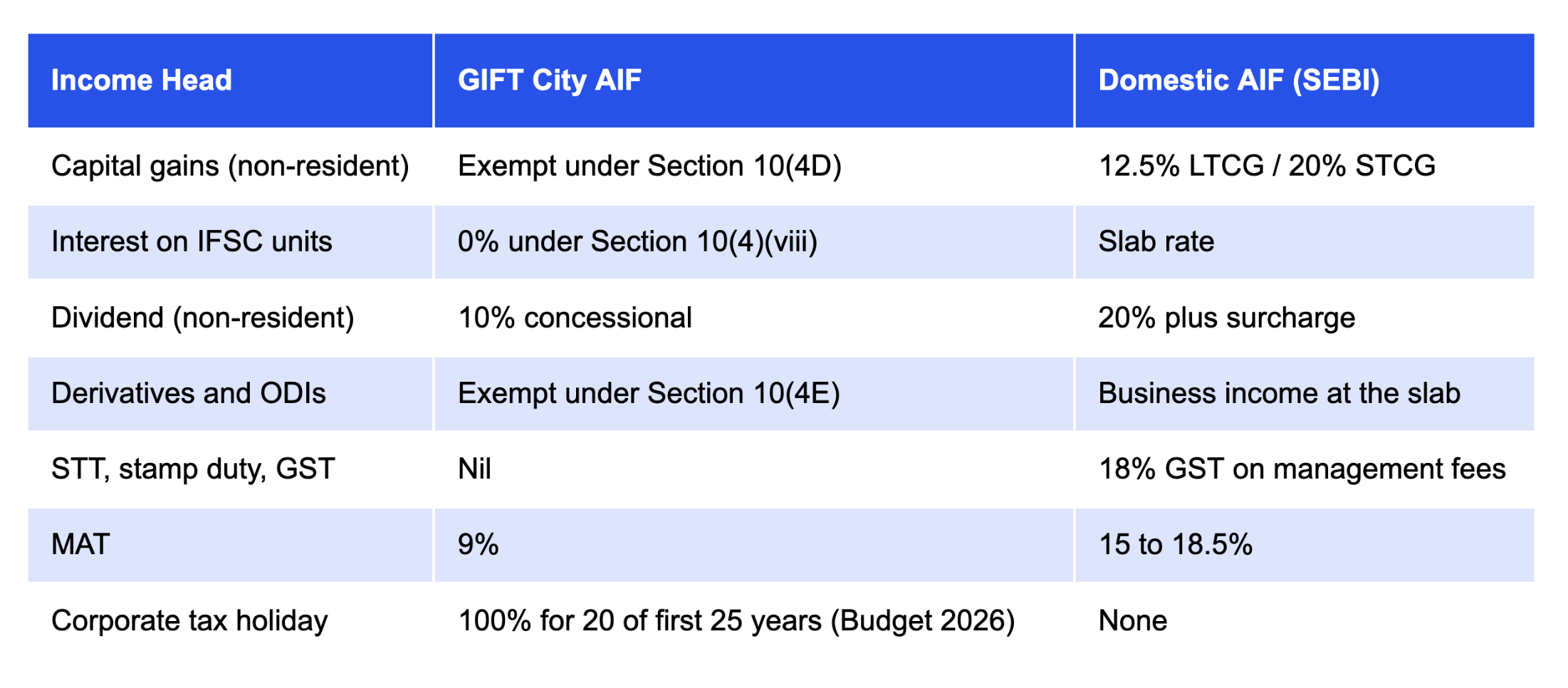
The tax architecture is the single largest differentiator. The table below summarises effective rates for Alternative Investment Funds in GIFT City versus domestic counterparts.
Beyond tax, four operational capabilities distinguish the regime.
- Full repatriation without RBI approval. Non resident investors withdraw principal and gains in foreign currency with no Form 15CA or 15CB compliance.
- PAN and ITR exemption for NRIs applies where the GIFT City AIF is the sole Indian income source and TDS is handled at fund level.
- Reduced minimum investment of USD 75,000 for specified schemes from February 2025, opening the accredited retail segment.
- Video KYC with AI face match and liveness detection became operational in July 2025, eliminating physical presence for NRI onboarding.
For UAE-based NRIs, the combined effect is a 0 percent effective tax rate. For US and UK NRIs, home country taxation applies, though DTAA relief under treaties with 90 plus countries softens the burden. Fund managers should build the investor base around non resident pools where after tax alpha is highest.
What Should Indian BFSI Firms Prioritise in 2026 and Beyond?
Three trends will shape the next phase. Mutual fund relocation from Singapore and Mauritius will accelerate once the April 2026 tax neutral migration window opens, potentially pulling an estimated US$50 billion in India dedicated AUM onshore.
Unified platforms, where a single FME licence operates PMS, Cat II, and Cat III AIFs with shared middle office, are cutting setup costs by 30 to 40 percent. Forward thinking BFSI firms will distribute via the India INX Global Access Platform and nominee tie ups with global private banks.
The winners will treat GIFT City as a multi decade wealth creation hub, moving from concept to first close in under nine months to capture early mover positioning before the framework fully standardises.
How Elefint Powers Your GIFT City AIF Journey
Building an AIF in GIFT City is a compliance, technology, and distribution challenge rolled into one. Elefint, a GIFT City based TechFin entity, partners with Indian BFSI firms across three layers. Our Digital Onboarding platform delivers IFSCA compliant video KYC with AI face match, liveness detection, and sanctions screening. Our Wealth Management technology stack supports PMS and AIF operations, including investor reporting, FATCA and CRS compliance, and PPM-driven workflows. Our Depository Operations solution, supported for IIDI, bridges fund vehicles with settlement infrastructure.
Ready to launch your GIFT City AIF? Talk to our team and build for the next decade of cross border capital.